Home Care vs Assisted Living: Complete 2026 Guide
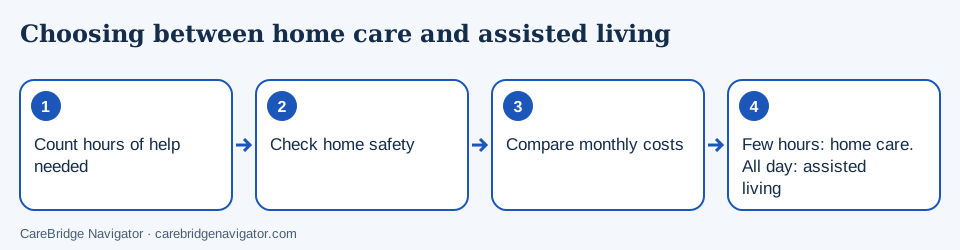
Home Care vs Assisted Living: Which Is Right for Your Family?
Choosing between home care and assisted living is one of the biggest decisions families face when caring for aging loved ones. Both options offer distinct advantages. The right choice depends on your loved one's specific needs, preferences, and financial situation.
Understanding Home Care
Home care allows seniors to receive assistance in the comfort of their own home. Services can range from basic companionship and light housekeeping to skilled nursing care.
#### Pros of Home Care
- Familiar environment — Seniors stay in their own home surrounded by memories and personal belongings.
- Seniors receive personalized one-on-one attention from a dedicated caregiver.
- Flexible scheduling adapts to your family's needs.
- Home care is often more affordable for people needing limited hours of care.
- Seniors keep greater independence and control over daily routines.
#### Cons of Home Care
- Home care can become expensive for 24/7 care (averaging $5,500-$6,500/month nationally).
- Social isolation can occur if the senior lives alone between caregiver visits.
- The home may need modifications for safety (grab bars, ramps, etc.).
- Caregiver turnover can be disruptive.
Understanding Assisted Living
Assisted living facilities provide housing, meals, personal care, and social activities in a community setting. They bridge the gap between independent living and nursing homes.
#### Pros of Assisted Living
- Residents have a built-in social community with activities and events.
- 24/7 staff availability provides support for emergencies.
- Meals, housekeeping, and transportation are included.
- Residents have a structured environment with consistent routines.
- Residents have no home maintenance worries.
#### Cons of Assisted Living
- Residents have less privacy than when living at home.
- Assisted living has an average cost of $4,500-$5,500/month nationally.
- The adjustment period can be emotionally challenging.
- Residents receive less personalized care due to staff-to-resident ratios.
- Assisted living may feel like a loss of independence.
Cost Comparison: 2026 Numbers
Service — National Average Monthly Cost
Home Care (44 hrs/week) — $5,720
Assisted Living — $4,885
Memory Care — $6,935
Key Questions to Help You Decide
1. How much daily assistance does your loved one need? If they need help with 3+ Activities of Daily Living (ADLs), assisted living may be more practical.
2. Is social isolation a concern? If your loved one lives alone and is becoming withdrawn, a community setting could improve their quality of life.
3. What is your budget? Calculate long-term costs for both options, including potential increases in care needs.
4. What does your loved one prefer? Their wishes should be central to the decision.
Making the Transition
Your family should plan for a gradual transition, whichever option you choose. Visit facilities multiple times, arrange trial stays, or start with part-time home care before committing to full-time support.
The Bottom Line
Neither option is universally "better." The best choice provides your loved one with the right level of care, social engagement, and comfort. The cost also needs to be manageable for your family. Many families start with home care and transition to assisted living as needs increase. That is perfectly okay.
CareBridge Navigator offers a free care assessment tool to help you explore both options. You can use the tool to start a personalized care plan.
Which option is cheaper at your parent's care level?
The crossover point determines the cheaper option for most families. Home care is billed by the hour, so cost rises in a straight line with need. Assisted living is billed monthly and is mostly flat.
Home care is usually cheaper up to roughly 25 to 30 hours a week. Above about 40 hours a week, assisted living typically costs less for the same amount of oversight because residents share staff support. A person needing overnight supervision or two-person transfers has usually passed the crossover already.
Families should add costs the hourly rate hides: property taxes, home insurance, utilities, maintenance, and grab bars or a stair lift. Families pay those costs separately at home, but the monthly assisted living fee includes them.
When is home care clearly the better choice?
- The help needed is a few hours a day, at predictable times.
- A spouse or an adult child is already in the house doing part of the work.
- The home is on one level or can be made safe without major construction.
- The person's judgment is intact, and they can call for help.
- Familiar surroundings offer meaningful protection. That is often true early in dementia.
When does assisted living become the safer choice?
- Nights are unsafe because the person wanders, falls, or wakes a spouse repeatedly.
- Transfers require two people.
- Medications are being missed even with reminders and a pill organizer.
- The caregiver at home is exhausted, ill, or has stopped seeing their own doctor.
- Isolation is causing visible harm, and the person has stopped eating or bathing regularly.
What questions separate a good option from a bad one?
Families considering home care should ask about caregiver turnover and who covers a missed shift. Ask whether the aide may give medications in your state and what the minimum shift is.
Families considering assisted living should ask what the base rate includes. Ask what triggers a move to a higher care level and a higher price. Ask about the staffing ratio overnight, not just during the day. Ask how many residents left in the last year and why. Then eat a meal there, unannounced, at dinner time.
How do you decide without regret?
Family members should write down the three moments in a week that worry them most. Price both options against those three moments only. The right option addresses those moments at a cost the family can sustain for two years. You can revisit the decision. Neither choice is permanent.
Sources
- Medicare.gov: home health services coverage
- Genworth and CareScout: cost of care survey
- Eldercare Locator (U.S. Administration for Community Living)
How this guide was written and reviewed
CareBridge Navigator guides are drafted with writing software and research tools, then checked line by line by Shanda Browning Vaughn, RN, a registered nurse since 2000. Shanda confirms every figure against the official sources listed on the page before a guide is published, and updates the guide when Medicare, Medicaid or VA rules change.
Related guides
- Assisted Living vs Nursing Home: Key Differences
- Assisted Living vs. Memory Care: Choosing for Dementia
- In-Home Care vs. Assisted Living: 2026 Cost & Lifestyle Guide
- Respite Care: A Lifeline for Family Caregivers
- Understanding Dementia: A Caregiver's Complete Guide
More from CareBridge Navigator
- About CareBridge Navigator
- Why Shanda built CareBridge Navigator
- Caregiver directory
- Caregiver community
- Caregiver tax credits
- EEOICPA benefits screener
- Care Agent
- Life Alarm medical alert
- Install the app
- Press and media
Free caregiver tools
- Free care roadmap
- Emergency fridge sheet
- Elder care checklist
- Caregiver questions answered
- Care settings compared
- Compare care options
- Resource directory
- Caregiver education library
More caregiver guides · Start your free CareBridge Navigator assessment