Understanding Dementia: A Caregiver's Complete Guide
Understanding Dementia: A Caregiver's Complete Guide
Caregivers supporting someone with dementia take on one of the most challenging — and meaningful — roles. The guide offers practical information for approaching each stage with confidence and compassion.
What Is Dementia?
Dementia is not a single disease but a general term for a decline in cognitive function. The decline is severe enough to interfere with daily life. Dementia affects:
- Memory — Forgetting recent events, names, or familiar tasks
- Thinking and reasoning — Difficulty with problem-solving and planning
- Language — Trouble finding words or following conversations
- Perception — Misinterpreting visual or spatial information
- Behavior — Personality changes, agitation, or withdrawal
Types of Dementia
#### Alzheimer's Disease
Alzheimer's disease is the most common form, accounting for 60-80% of cases:
- Alzheimer's disease begins gradually and progresses slowly.
- Early signs include memory loss and confusion.
- Average duration is 8-12 years after diagnosis.
#### Vascular Dementia
Vascular dementia is the second most common type:
- Vascular dementia results from reduced blood flow to the brain, often after strokes.
- Vascular dementia may progress in sudden steps rather than gradually.
- Risk factors include high blood pressure, diabetes, and heart disease.
#### Lewy Body Dementia
- Lewy body dementia involves visual hallucinations and fluctuating alertness.
- Movement problems resemble those of Parkinson's disease.
- People with Lewy body dementia have extreme sensitivity to certain medications.
#### Frontotemporal Dementia
- Frontotemporal dementia affects personality, behavior, and language early on.
- Frontotemporal dementia is typically diagnosed at a younger age (40s-60s).
- Memory may remain relatively intact in early stages.
The Stages of Dementia
#### Early Stage (Mild)
- Memory problems include forgetting recent conversations or events.
- Difficulty with complex tasks includes problems managing finances.
- Navigation problems include getting lost in familiar places.
- Mood changes — anxiety, depression, or irritability
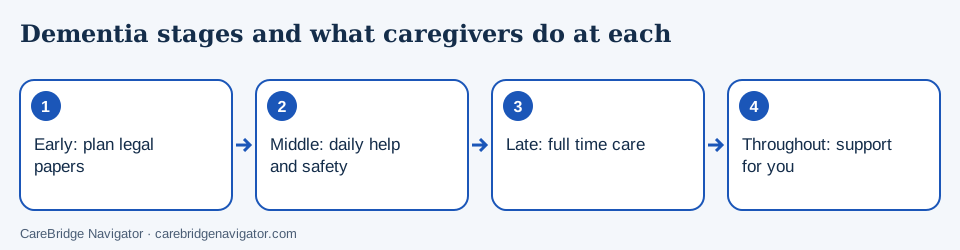
What caregivers can do: Caregivers can help organize systems, such as medication reminders and calendars. Discuss future care preferences and legal planning while your loved one can still participate.
#### Middle Stage (Moderate)
- Significant memory gaps may prevent the person from recognizing some family members.
- Daily activities require help with dressing, bathing, and toileting.
- Behavioral changes — wandering, sundowning, repetitive questions
- Sleep disturbances become more common.
What caregivers can do: Caregivers can establish consistent routines and simplify the home environment. Join a caregiver support group and begin exploring additional care support.
#### Late Stage (Severe)
- Extensive memory loss may prevent the person from recognizing close family.
- Loss of physical abilities — walking, swallowing, bladder control
- Communication becomes very limited.
- Care needs require round-the-clock support.
What caregivers can do: Caregivers can focus on comfort, sensory experiences (music, gentle touch), and maintaining dignity. Consider hospice care when appropriate.
Communication Strategies
#### Do
- Caregivers should use simple, clear sentences, with one idea at a time.
- Caregivers should make eye contact and speak slowly.
- Caregivers should use the person's name to get their attention.
- Caregivers should offer limited choices. Ask, "Would you like coffee or tea?" rather than "What do you want to drink?"
- Caregivers should use visual cues and gestures alongside words.
- Caregivers should validate feelings even if the facts are confused.
#### Don't
- Caregivers should avoid arguing or correcting. Arguing and correcting cause frustration without benefit.
- Caregivers should avoid saying "remember?" The question highlights the person's difficulties.
- Caregivers should avoid talking about the person as if the person were not there.
- Caregivers should avoid rushing. Allow extra time for responses.
- Caregivers should avoid taking hurtful words personally. The disease is speaking, not your loved one.
Home Safety Essentials
- Caregivers should remove tripping hazards (throw rugs, clutter, cords).
- Caregivers should install locks on exits and consider door alarms.
- Caregivers should remove or lock up medications, cleaning supplies, and sharp objects.
- Caregivers should install grab bars in bathrooms and stairways.
- Caregivers should improve lighting throughout the home.
- Caregivers should put ID bracelets on the person, with the person's name and contact information.
- Caregivers should consider GPS tracking devices for people who wander.
- Caregivers should remove stove knobs or install auto-shutoff devices.
When to Seek Additional Help
- The caregiver feels overwhelmed more days than not.
- The caregiver's own health is declining.
- The person's needs exceed what the caregiver can safely provide.
- Behavioral issues become unmanageable.
- The caregiver is experiencing depression or anxiety.
CareBridge Navigator offers resources and community support for dementia caregivers. Caregivers do not have to manage dementia care alone.
What changes as dementia progresses?
Dementia is not one condition and does not progress in a straight line. Caregivers benefit from knowing roughly which problems belong to each stage. Knowing the stages helps you plan one step ahead instead of reacting.
Early dementia affects short-term memory, judgement and organizing. Bills get missed, appointments get double-booked, and the same story repeats. The person usually knows something is wrong. That awareness explains why this stage carries so much anxiety and defensiveness.
The middle stage makes help with daily activities necessary. Bathing, dressing and toileting need prompting or hands-on help. Wandering, sundowning, accusations and repeated questions appear here. The middle stage is the longest and the hardest on caregivers.
Late-stage dementia brings loss of speech, loss of mobility, swallowing difficulty and full dependence for care. Medical needs dominate, and infections and pressure wounds are the main risks.
How should you handle repeated questions and false accusations?
Caregivers should avoid correcting or arguing. The person's brain cannot be talked out of the belief. Trying makes both people angrier.
Caregivers should respond to the feeling. A person asking repeatedly when their mother is coming is usually anxious, not confused about a fact. Saying, "She is not here right now. Would you help me with this?" works better than stating the truth plainly.
Accusations about stolen money or a hidden purse are a symptom. Keep duplicates of frequently lost items. Search together rather than defending yourself. Write down when accusations happen. The pattern usually points to a time of day or a trigger.
What makes daily care easier?
- Caregivers should keep the same order of events every day. Routine substitutes for memory.
- Caregivers should offer one choice at a time, not open questions.
- Caregivers should break tasks into single steps and say one step at a time.
- Caregivers should use short sentences, approach from the front, and wait longer than feels natural for an answer.
- Caregivers should reduce noise during tasks. Turn off the television before talking.
- Caregivers should label drawers and doors with words and pictures.
- Caregivers should simplify clothing: elastic waists, slip-on shoes, layers instead of buttons.
What safety steps matter most?
Caregivers should remove or lock up car keys once driving is unsafe. Ask the doctor to make that decision rather than taking responsibility alone. Set the water heater to 120 degrees. Lock medications, cleaning products and firearms. Put a stove knob cover or an automatic shutoff on the range.
Caregivers should register with a wandering response service and put a GPS device on the person if wandering has started. Keep a current photo and a written description ready in your phone. The first hour matters if someone leaves.
When should the family get help for itself?
Families should seek help earlier than most do. Ask for a referral to a geriatrician or a memory clinic. Call the Alzheimer's Association helpline at 1-800-272-3900. The helpline answers 24 hours a day. Call the Eldercare Locator at 1-800-677-1116 for respite, adult day programs and meal delivery in your ZIP code.
Caregivers should get legal documents signed while their parent can still sign them. Get a caregiver support group on your calendar before you need one.
Sources
- National Institute on Aging: Alzheimer's and dementia caregiving
- Alzheimer's Association
- Alzheimer's Association 24/7 Helpline: 1-800-272-3900
How this guide was written and reviewed
CareBridge Navigator guides are drafted with writing software and research tools, then checked line by line by Shanda Browning Vaughn, RN, a registered nurse since 2000. Shanda confirms every figure against the official sources listed on the page before a guide is published, and updates the guide when Medicare, Medicaid or VA rules change.
Related guides
- Sundowning in Dementia: Causes, Symptoms, and Solutions
- Understanding the Stages of Grief as a Caregiver
- Talking to Aging Parents About Assisted Living: A Step-by-Step Guide
- Long-Term Care Insurance: Is It Worth the Cost?
- Assisted Living vs Nursing Home: Key Differences
More from CareBridge Navigator
- About CareBridge Navigator
- Why Shanda built CareBridge Navigator
- Caregiver directory
- Caregiver community
- Caregiver tax credits
- EEOICPA benefits screener
- Care Agent
- Life Alarm medical alert
- Install the app
- Press and media
Free caregiver tools
- Free care roadmap
- Emergency fridge sheet
- Elder care checklist
- Caregiver questions answered
- Care settings compared
- Compare care options
- Resource directory
- Caregiver education library
More caregiver guides · Start your free CareBridge Navigator assessment