Talking to Aging Parents About Assisted Living: A Step-by-Step Guide
Short answer: Start the assisted living conversation early, before a crisis, and lead with safety and independence rather than loss. Share specific observations, ask what matters most to your loved one, and tour communities together. Expect several conversations; the goal is a shared decision, not a single talk that settles everything.
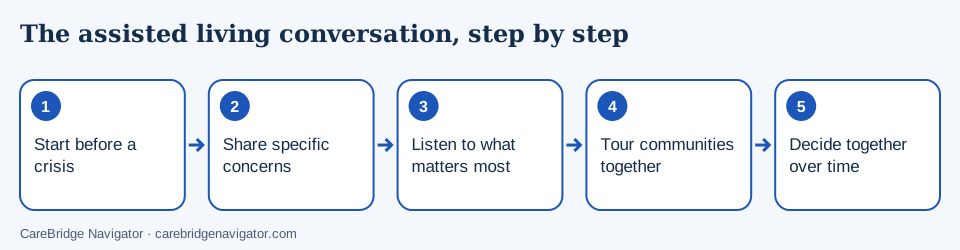
Family caregivers often face a difficult but important conversation: discussing a potential move to assisted living with an aging parent. The conversation goes beyond logistics. It means acknowledging changing needs, respecting your parent's choices, and supporting their continued safety and well-being. The guide offers a step-by-step approach with caring scripts to help you discuss a move with love, understanding, and practical support.
The Importance of Early, Open Conversations
Conversations about assisted living can make a significant difference when families start early and often. Don't wait for a crisis. Instead, include the topic in ongoing family discussions. Think of several smaller conversations rather than one high-pressure confrontation. Early discussions give your parent time to consider the idea and feel more involved in decisions. They also reduce the chance of your parent feeling ambushed or pressured. Families can explore preferences and concerns before help becomes urgent.
- Regular Check-ins: Family caregivers can regularly ask about their parent's daily life, challenges, and hopes.
- Active Listening: Family caregivers should notice subtle cues—frustrations with household chores, loneliness, or safety concerns.
- Respectful Approach: Conversations should focus on your parent's well-being, independence, and desire for a fulfilling life.
Step 1: Laying the Groundwork – Observation and Research
Preparation matters before family caregivers mention "assisted living." Take time to understand your parent's situation and gather information for the conversation.
Observe and Document Specific Concerns
Family caregivers can quietly observe their parent's daily life. Look for patterns and specific examples of growing difficulty managing independently. Your observations can help explain your concerns and provide clear examples during the conversation.
- Home Safety: Has your parent experienced falls, near-falls, or difficulty with stairs? Is the home well-maintained, or are repairs piling up?
- Personal Care: Is your parent neglecting hygiene, having trouble dressing, or forgetting medications?
- Nutrition: Is your parent eating regularly and healthily? Is the refrigerator stocked with fresh food, or is expired food common?
- Social Isolation: Is your parent withdrawing from social activities? Do they express loneliness or boredom?
- Cognitive Changes: Does your parent experience memory loss, confusion, or difficulty managing finances?
Research Assisted Living Options and Costs
Research helps family caregivers prepare. Before the conversation, learn what assisted living involves, which programs might help with costs, and what options are available locally. Your research can help you offer informed solutions, not just raise problems.
- Types of Care: Family caregivers should understand the differences between independent living, assisted living, memory care, and skilled nursing facilities.
- Local Facilities: Family caregivers can identify a few reputable assisted living communities nearby. Look at their services, amenities, and resident reviews.
- Financial Considerations: The average cost of assisted living often ranges from $4,500 to $7,500 per month, depending on location and services. Research costs and explore potential funding sources like:
* Long-Term Care Insurance: Your parent's policy may be a funding source, if they have one.
* VA Aid & Attendance: Eligible veterans and surviving spouses may qualify for help.
* Medicaid: Medicaid typically covers skilled nursing. Some states have Medicaid Home and Community-Based Services (HCBS) waivers. These can help with assisted living costs for people with low income and assets.
* Private Pay: Payments often come from savings, pensions, or the sale of a home.
* EEOICPA (Energy Employees Occupational Illness Compensation Program Act): The program provides benefits for certain workers. Benefits might include funds for care.
* Social Security: Social Security provides a baseline income but rarely covers the full cost of assisted living.
Typical Assisted Living Costs Comparison
Cost Factor — Range Per Month — Notes
Base Rent — $3,000 - $6,000 — Varies by location, size, and amenities
Care Services (add-ons) — $500 - $2,000 — Tiered based on individual care needs
Medication Management — $200 - $500 — Often an additional fee
Personal Care Assistance — Included or Capped — Bundled with care services, or per-task
Avg. Total Monthly Cost — $4,500 - $7,500 — National average; highly dependent on location
Step 2: Choosing the Right Time and Setting for the Conversation
The setting and timing of your conversation are almost as important as your words. Choose a comfortable, private place without distractions.
- Timing: Family caregivers should choose a time when everyone feels relaxed, rather than rushed, stressed, or tired. Avoid times immediately before or after a major event or appointment.
- Location: Your parent's home is usually best because the surroundings are familiar. Sit face-to-face, ideally at a kitchen table or in a living room, rather than across a doctor's desk.
- Attendees: One or two close family members may be best for the first conversation. A large group can feel overwhelming or confrontational. Later, include other siblings or a trusted friend if needed.
Step 3: Initiating the Conversation with Empathy and "I" Statements
Family caregivers should approach the conversation with genuine empathy. Remember, the discussion concerns significant life changes, not just a service. Use "I" statements to express your feelings and observations without sounding accusatory.
Openers and Scripts
- Focus on Love and Concern:
* "Mom/Dad, I love you very much. I've noticed a few things lately that concern me about your well-being."
* "Your independence matters to me. I want you to live safely and comfortably for as long as possible."
- Highlight Specific Observations (Gently):
* "Housework seems to be getting harder for you. I've noticed the change, and I sometimes worry about you being alone." (Instead of: "Your house is a mess.")
* "Your experience with [specific incident, e.g., the near-fall, forgetting to eat] has worried me since you mentioned it." (Instead of: "You're not safe here anymore.")
- Ask Open-Ended Questions:
* "How does living here on your own feel these days?"
* "What challenges at home feel hardest for you right now?"
* "What changes would make your life easier or more enjoyable?"
- Introduce the Concept Broadly:
* "What living situation have you considered as you get older?"
* "Some living options for seniors offer more support and social opportunities. I've been researching different options, and I thought we could discuss them."
Step 4: Actively Listen and Validate Their Feelings
Your parent will likely have strong emotions—fear, anger, sadness, or a sense of losing control. Listen more than you speak. Acknowledge their feelings, even when you disagree. Showing your parent that you hear and understand their perspective helps build trust.
Empathetic Responses
- "A move can be difficult to think about, and I understand why. It's a big change, and those feelings are normal."
- "Losing your independence sounds like a worry for you. That's a completely valid concern."
- "Your home means a lot to you; I hear that. Your feelings make perfect sense. We all have strong connections to our homes."
- "What aspects of assisted living concern you most?"
Step 5: Focus on Benefits and Solutions, Not Deficits
Assisted living can offer benefits and solutions. Focus on those possibilities rather than what your parent can no longer do. Frame the conversation around gaining support, not losing abilities.
Highlighting Advantages
- Safety and Security: "Stairs and home maintenance wouldn't need to be worries. Someone would always be nearby if you needed help."
- Social Connection: "Many communities offer activities, outings, and chances to make new friends. Those connections can help with loneliness."
- Freedom from Chores: "Cooking, cleaning, and yard work wouldn't take up your time. You could focus on hobbies and other things you enjoy."
- Nutritious Meals: "Tasty, healthy meals would be prepared for you every day. You wouldn't have to worry about shopping or cooking."
- Access to Support: "Professional help with medications or personal care could give both of us peace of mind."
- Maintaining Independence: "Assisted living often supports independence by offering the right level of help. You can focus your energy on what matters most to you."
Step 6: Collaborative Problem-Solving and Next Steps
Your parent should be a partner in the decision. Emphasize that you will explore options together, and involve them throughout the process.
- Offer Choices: "Several communities are nearby. Would you be open to visiting one or two with me, just to see what they're like?"
- "A lunch tour could let us visit a place that looks promising – no commitment, just a look."
- Address Specific Concerns: Your parent's concerns deserve direct answers when possible. If you don't know the answer, commit to finding out.
- Patience is Key: The conversation may take several attempts over weeks or months. Don't expect an immediate "yes." Introduce the idea, follow up, and revisit the discussion.
- Seek Third-Party Involvement (If Needed): A trusted doctor, geriatric care manager, or respected family friend may help reinforce your message.
Frequently Asked Questions
How do I start the conversation if my parent refuses to acknowledge their needs?
Sources
- National Institute on Aging: caregiving
- Family Caregiver Alliance
- Eldercare Locator (U.S. Administration for Community Living)
How this guide was written and reviewed
CareBridge Navigator guides are drafted with writing software and research tools, then checked line by line by Shanda Browning Vaughn, RN, a registered nurse since 2000. Shanda confirms every figure against the official sources listed on the page before a guide is published, and updates the guide when Medicare, Medicaid or VA rules change.
Related guides
- Hospice Care: When Is It the Right Time?
- How to Create a Caregiver Burnout Prevention Plan
- Respite Care: A Lifeline for Family Caregivers
- VA Benefits for Senior Care: Complete 2026 Guide
- How to Talk to Aging Parents About Needing Help
More from CareBridge Navigator
- About CareBridge Navigator
- Why Shanda built CareBridge Navigator
- Caregiver directory
- Caregiver community
- Caregiver tax credits
- EEOICPA benefits screener
- Care Agent
- Life Alarm medical alert
- Install the app
- Press and media
Free caregiver tools
- Free care roadmap
- Emergency fridge sheet
- Elder care checklist
- Caregiver questions answered
- Care settings compared
- Compare care options
- Resource directory
- Caregiver education library
More caregiver guides · Start your free CareBridge Navigator assessment