How to Talk to Aging Parents About Needing Help
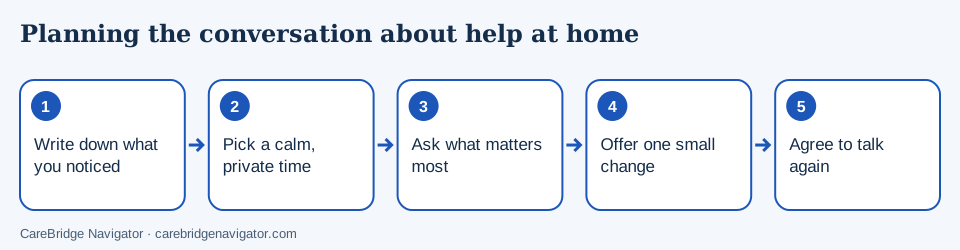
How to Talk to Aging Parents About Needing Help
A parent's need for help can be easier to notice than to discuss. The conversation is among the most emotionally charged discussions families face. Empathy and preparation can help families reach a positive outcome.
Recognizing the Signs
Caregivers should identify specific concerns before starting the conversation:
- Missed medications or confusion about dosages
- Unpaid bills or unusual financial decisions
- Weight loss or an empty refrigerator
- Poor hygiene or wearing dirty clothes
- Increased falls or unexplained bruises
- Social withdrawal or missed appointments
- Unsafe driving incidents
- Home in disrepair or unusually messy
Preparing for the Conversation
#### Choose the Right Time and Place
- Caregivers should pick a calm, private setting — not a holiday gathering.
- The conversation should happen when everyone is rested and not rushed.
- Caregivers should avoid starting the conversation after an incident when emotions are high.
#### Get on the Same Page with Siblings
- Siblings should talk beforehand to present a united front.
- Siblings should agree on concerns and potential solutions.
- Siblings should decide who will lead the conversation.
- The whole family should avoid ambushing the parent.
#### Lead with Love and Respect
The conversation should focus on concern for your parent's well-being, not shortcomings:
Instead of: A caregiver saying, "You can't take care of yourself anymore."
Try: A caregiver saying, "I love you and want to make sure you're safe and comfortable."
Instead of: A caregiver saying, "You need to stop driving."
Try: A caregiver saying, "I worry about you on the road. Can we talk about transportation options?"
Instead of: A caregiver saying, "You're moving to assisted living."
Try: A caregiver saying, "Let's explore some options together to make daily life easier."
During the Conversation
#### Listen More Than You Speak
- Caregivers can ask open-ended questions: "How are you feeling about managing things at home?"
- Caregivers can validate their parent's feelings: "I understand this is hard to talk about."
- Caregivers can acknowledge their parent's autonomy: "I want to include you in these decisions."
#### Focus on Specific Concerns
Caregivers should mention specific observations rather than vague worries:
- A caregiver might say, "I noticed the bills on the counter are past due. That's not like you."
- A caregiver might say, "Your neighbor mentioned you seemed confused last Tuesday."
- A caregiver might say, "Dr. Smith called and said you missed your last two appointments."
#### Offer Solutions, Not Ultimatums
Caregivers should present options rather than demands:
- A caregiver might ask, "Would you be open to someone coming a few hours a week to help with housework?"
- A caregiver might ask, "What if we set up automatic bill pay so you don't have to worry about it?"
- A caregiver might ask, "Would you like to try a meal delivery service?"
If They Resist
Resistance is normal. Your parent may feel:
- Fear of losing independence
- Denial about declining abilities
- Shame about needing help
- Anger at being told what to do
#### Strategies for Resistance
1. Caregivers should avoid forcing the issue. Introduce the idea and revisit the conversation later.
2. Caregivers can involve their parent's doctor. Sometimes parents listen to professionals more than family.
3. Caregivers can start small. Suggest a cleaning service before discussing full-time care.
4. Caregivers can use their parent's values: "You always told me to plan ahead. Let's do that together."
5. Caregivers should be patient. The discussion may take multiple conversations over weeks or months.
When Safety Is at Immediate Risk
A parent in immediate danger may need faster action. Examples include wandering, leaving the stove on, and serious medication errors:
- Caregivers should contact their parent's primary care physician.
- Caregivers should call Adult Protective Services if self-neglect is suspected.
- Caregivers should consult an elder law attorney about guardianship if necessary.
After the Conversation
- Caregivers should follow up within a few days to show care.
- Caregivers and parents should take small steps together toward the agreed-upon plan.
- Caregivers should document decisions and next steps.
- Caregivers should keep the door open for future conversations.
CareBridge Navigator provides tools and resources to help families through these changes together. Families can start with the free care assessment.
When is the right time to start the conversation?
The conversation should start before a crisis. An ordinary afternoon is best, when nobody is in the hospital and no decision is needed that day.
Good openings are worth waiting for. Examples include a friend's recent move, a neighbour's fall, a news story, or a hospital visit that went fine. Each opening offers a chance to ask what your parent would want if something similar happened.
What should you say, and what should you avoid?
Your parent's goals should guide the conversation, rather than your worries. Ask what would need to happen for your parent to stay in the house for another five years. Most people answer honestly, and the answer gives you a list of tasks.
Caregivers should avoid phrases that end conversations: "you can't," "you need to," "we've decided," and "it's not safe anymore." Avoid bringing three siblings and a binder to a first conversation.
Caregivers can use these questions instead:
- A caregiver can ask, "What matters most to you about how you live now?"
- A caregiver can ask, "What would you want us to do if you couldn't tell us?"
- A caregiver can ask, "Who would you want making decisions for you?"
- A caregiver can ask, "What are you finding harder than before?"
Caregivers should then stop talking. Let the silence do some work.
What do you do when your parent says no?
Caregivers should expect a no. Refusal is almost always about losing control, not the specific help offered.
Caregivers can make the request smaller. Instead of a caregiver, suggest someone to do the heavy cleaning on Thursdays. Instead of giving up driving, suggest not driving at night. Instead of moving, suggest a grab bar in the shower. Small yeses build trust for the bigger conversation later.
Your parent should have the authority. Let your parent interview the caregiver, set the schedule, and fire someone who is a bad fit.
A third voice can help when your words no longer do. Many parents accept advice from a doctor, pastor, or old friend but reject the same advice from a child. Ask the doctor to raise driving or home safety at the next appointment.
Which decisions cannot wait?
Some arrangements must be in place before capacity declines. After that, a court is required.
- Durable power of attorney for finances.
- Health care power of attorney and an advance directive.
- HIPAA authorization so doctors may talk to you.
- A list of accounts, passwords, insurance policies and where the documents live.
Caregivers should explain that these arrangements help ensure the parent's wishes are followed. The purpose is honoring those wishes, not completing paperwork about dying.
How do you keep siblings from derailing it?
Siblings should agree among themselves before anyone talks to the parent. One person leads the conversation. Everyone else agrees not to reopen the debate in front of the parent.
Siblings should then divide tasks by what each person can actually do, rather than by fairness. The sibling nearby handles appointments. The distant sibling handles insurance calls, benefits paperwork, and bills. Write down the plan, because relying on memory can lead to sibling resentment.
Sources
- National Institute on Aging: caregiving
- Family Caregiver Alliance
- Eldercare Locator (U.S. Administration for Community Living)
How this guide was written and reviewed
CareBridge Navigator guides are drafted with writing software and research tools, then checked line by line by Shanda Browning Vaughn, RN, a registered nurse since 2000. Shanda confirms every figure against the official sources listed on the page before a guide is published, and updates the guide when Medicare, Medicaid or VA rules change.
Related guides
- Top 10 Questions to Ask When Touring Assisted Living
- Creating a Safe Home for Aging in Place
- Navigating Family Disagreements About Elder Care
- In-Home Care Costs by State: 2026 Guide
- Hospice Care: When Is It the Right Time?
More from CareBridge Navigator
- About CareBridge Navigator
- Why Shanda built CareBridge Navigator
- Caregiver directory
- Caregiver community
- Caregiver tax credits
- EEOICPA benefits screener
- Care Agent
- Life Alarm medical alert
- Install the app
- Press and media
Free caregiver tools
- Free care roadmap
- Emergency fridge sheet
- Elder care checklist
- Caregiver questions answered
- Care settings compared
- Compare care options
- Resource directory
- Caregiver education library
More caregiver guides · Start your free CareBridge Navigator assessment