Creating a Safe Home for Aging in Place
Creating a Safe Home for Aging in Place
Nearly 90% of seniors say they want to remain in their own home through older age. With the right modifications, aging in place can be safe, comfortable, and significantly more affordable than facility-based care.
Why Home Safety Matters
Falls are the leading cause of injury among adults 65 and older:
- One in four seniors falls each year
- Falls result in 3 million emergency room visits annually
- Hip fractures from falls are associated with a significant risk of death
- Many falls are preventable with simple home modifications
Room-by-Room Safety Guide
#### Bathroom (Highest Risk Area)
The bathroom is where most home falls occur. Priority modifications include:
- Grab bars near the toilet and in the shower/tub (professionally installed into wall studs)
- Non-slip mats or adhesive strips in the tub and on the floor
- Walk-in shower or tub-to-shower conversion (removes the need to step over a tub wall)
- Raised toilet seat or comfort-height toilet
- Handheld showerhead for seated bathing
- Shower chair or transfer bench
- Good lighting including a nightlight
Estimated cost: $500-$5,000, depending on the modifications needed.
#### Kitchen
- Lever-style faucets and handles (easier than knobs for arthritic hands)
- Pull-out shelves in lower cabinets to reduce bending and reaching
- Automatic stove shut-off device for safety
- Non-slip flooring — Remove throw rugs
- Adequate lighting on countertops and work areas
- Reachable storage — Move frequently used items to waist-height cabinets
- Easy-grip utensils and jar openers
Estimated cost: $200-$3,000.
#### Bedroom
- Bed at proper height — Knees should be at 90 degrees when sitting on the edge
- Nightlights along the path to the bathroom
- Bedside lamp within easy reach
- Phone and emergency alert device on the nightstand
- Clear path from bed to bathroom (no obstacles or cords)
- Firm mattress that's easy to get in and out of
Estimated cost: $100-$1,000.
#### Stairs and Hallways
- Handrails on both sides of all stairways
- Non-slip treads on every step
- Bright, even lighting throughout
- Contrast strips on the edge of each step
- Stair lift if stairs become too difficult ($3,000-$8,000)
- A first-floor bedroom to eliminate stair use
Estimated cost: $200-$8,000.
#### Entryways
- Ramp if there are steps (can be permanent or portable)
- Lever door handles instead of round knobs
- Motion-sensor exterior lighting
- Covered entry for weather protection
- Bench or chair near the door for removing shoes
- Sturdy handrails
Estimated cost: $500-$5,000 for a ramp.
Technology for Safety
Modern technology can make a significant difference in safety:
- Medical alert systems — Wearable devices with fall detection ($25-$50/month)
- Smart home sensors — Motion sensors that alert family to unusual patterns
- Video doorbells — See and communicate with visitors remotely
- Medication dispensers — Automated reminders and dispensing ($30-$100/month)
- Smart speakers — Voice-controlled calls, reminders, and entertainment
- GPS tracking — For seniors with dementia who may wander
Paying for Home Modifications
Several programs can help cover costs:
- Medicaid HCBS waivers — Many states cover home modifications
- VA grants — Specially Adapted Housing (SAH) and Home Improvement grants for veterans
- USDA Rural Housing Repair Loans — For homeowners in rural areas
- Area Agency on Aging — May offer grants or low-interest loans
- Rebuilding Together — Nonprofit providing free home modifications for low-income seniors
- Tax deductions — Medical-related home modifications may be deductible
Hiring a Professional Assessment
A Certified Aging-in-Place Specialist (CAPS) can provide a thorough home evaluation:
- A CAPS professional receives training from the National Association of Home Builders
- The specialist evaluates every room and pathway for safety risks
- The specialist provides a prioritized modification plan with cost estimates
- The specialist can recommend contractors experienced in accessibility modifications
Assessment cost: $150-$500 (often worth the cost).
Planning for the Future
Home modifications should account for future needs:
- Doorways should be widened to 36 inches for potential wheelchair access
- Blocking in bathroom walls should be installed for future grab bar installation
- Single-level living is worth choosing if possible
- A zero-step entry to the home should be part of the plan
- Universal design principles are worth considering — Modifications that look good and work for everyone
CareBridge Navigator provides a care assessment and resource directory for planning to age in place. The directory helps you find local contractors and funding options.
Which changes prevent the most falls?
Falls end aging in place, so start where the risk is concentrated.
- Throw rugs should be removed entirely or taped down on all four edges. Loose rugs cause more falls than stairs.
- Grab bars should be bolted into studs beside the toilet and inside the shower. A towel rail or a suction bar will not hold a falling adult.
- The tub needs a non-slip mat, and the shower stall needs a shower chair and handheld showerhead.
- The toilet seat should be raised, or a raised seat with arms should be fitted.
- Motion-sensor nightlights should light the path from the bed to the bathroom.
- Uneven thresholds should be fixed or removed, and walkways should be cleared of all cords.
- Stairs need a second handrail for support on both sides. Mark the top and bottom step edges with contrasting tape.
What should be done room by room?
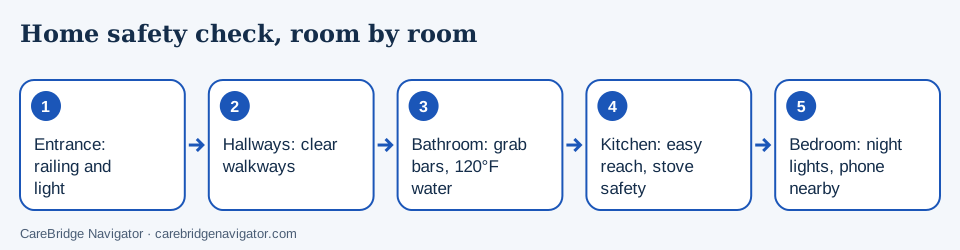
Kitchen dishes and food used daily should be stored at waist height so nothing requires a step stool. Fit lever taps instead of round knobs. Consider a stove with automatic shutoff, or a knob cover.
A bedroom lamp and phone should be within reach of the bed. Set the bed height so feet rest flat on the floor when sitting.
The bathroom water heater should be set to 120 degrees to prevent scalds. Make sure the bathroom door opens outward if possible. An outward-opening door cannot be blocked by someone who has fallen.
The entrance needs a railing on outdoor steps and good lighting over the door. Keep one step-free entry if the house allows.
Which changes matter for eyesight and hearing?
Ageing eyes need roughly three times the light of younger ones, and glare is as much a problem as dimness. Increase overall light levels, use shades on bare bulbs, and put task lighting where reading and cooking happen.
Contrasting colours should take priority over matching decor. A dark toilet seat against a light floor helps someone with reduced depth perception. A coloured plate against a white tablecloth and tape on step edges also help. Reduce background noise in the room where conversations happen. Hearing loss and hard surfaces together make speech unintelligible.
What does it cost, and who helps pay?
Most of the work offering good value is inexpensive: nightlights, tape, a shower chair, grab bars, and a raised toilet seat. Bathroom remodels, stair lifts and ramps are the expensive items.
Sources of help exist, and most families never ask.
- The Area Agency on Aging, through the Eldercare Locator at 1-800-677-1116, funds small home modification grants in many areas.
- USDA Section 504 loans and grants help low-income rural homeowners.
- Medicaid home and community-based waivers cover modifications in many states.
- The VA offers Home Improvements and Structural Alterations grants, plus Specially Adapted Housing grants for eligible veterans.
- Habitat for Humanity affiliates and local Rebuilding Together chapters do free safety work for qualifying households.
Medicare does not pay for home modifications. Medicare does cover some durable medical equipment, such as a walker, wheelchair or hospital bed, when prescribed by a doctor.
Who should assess the home?
The doctor can provide a referral to an occupational therapist for a home safety evaluation. Ask for a referral. Medicare often covers the evaluation. An hour with an occupational therapist (OT) catches risks a family walks past every day.
A nighttime walk through the house should follow the route from the bed to the bathroom in the dark. Take that walk next. The walk finds most of what a checklist misses.
Sources
- CDC: STEADI older adult fall prevention
- National Institute on Aging: aging in place
- Eldercare Locator (U.S. Administration for Community Living)
How this guide was written and reviewed
CareBridge Navigator guides are drafted with writing software and research tools, then checked line by line by Shanda Browning Vaughn, RN, a registered nurse since 2000. Shanda confirms every figure against the official sources listed on the page before a guide is published, and updates the guide when Medicare, Medicaid or VA rules change.
Related guides
- Navigating Family Disagreements About Elder Care
- How to Talk to Aging Parents About Needing Help
- Top 10 Questions to Ask When Touring Assisted Living
- Advance Directives and Living Wills: Step-by-Step for Families in 2026
- Guardianship vs. Conservatorship: Which Does Your Parent Need?
More from CareBridge Navigator
- About CareBridge Navigator
- Why Shanda built CareBridge Navigator
- Caregiver directory
- Caregiver community
- Caregiver tax credits
- EEOICPA benefits screener
- Care Agent
- Life Alarm medical alert
- Install the app
- Press and media
Free caregiver tools
- Free care roadmap
- Emergency fridge sheet
- Elder care checklist
- Caregiver questions answered
- Care settings compared
- Compare care options
- Resource directory
- Caregiver education library
More caregiver guides · Start your free CareBridge Navigator assessment