Guardianship vs. Conservatorship: Which Does Your Parent Need?
Short answer: Guardianship gives a court appointed person authority over personal and medical decisions, while conservatorship covers money and property. Both remove rights, so courts treat them as a last resort. If an older adult can still sign documents, a power of attorney and health care proxy are usually faster, cheaper, and less restrictive options.
Recognizing an aging parent's need for help with major life decisions is an important step. Many adults become less able to manage their affairs as they age. Cognitive impairment, physical limitations, or other health challenges may cause this decline. Families in the United States have two main legal options for providing support: guardianship and conservatorship. People often use these terms interchangeably, but the arrangements grant different powers. Guardianship protects personal well-being, while conservatorship protects financial assets. Understanding the right option for your parent can help prevent unnecessary stress, legal complications, and financial burdens. The guide explains the differences, court process, costs, timelines, and alternatives. The guide also offers practical advice for navigating these legal options.
Guardianship: Personal and Medical Decisions
Guardianship is a legal process in which a court appoints a person, called the guardian, to make another person's personal and medical decisions. The person receiving support, called the ward, must have been found legally incapacitated. Incapacity means the person cannot make reasoned decisions about their health, safety, and general well-being. The guardian's responsibilities can include decisions about housing, medical treatment, daily care, social activities, and even visitors.
A guardian might decide that the ward needs to move from an independent living facility to a skilled nursing home. The guardian might also approve surgery or ensure the ward receives appropriate palliative care. The court determines the guardian's authority, granting only the powers necessary to protect the ward. A limited guardianship may allow the ward to keep control over some parts of their life. The guardian handles specific areas where the ward cannot make decisions.
A guardianship petition must be filed with the appropriate court, typically a probate or family court. The court requires evidence that the person believed to be incapacitated cannot make decisions. Evidence usually includes a medical evaluation from a qualified physician and often a psychological or cognitive assessment. These evaluations provide professional insight into the person's mental and physical condition. The court also appoints an attorney to represent the person and protect their rights throughout the proceedings. This representation is an essential safeguard against misuse of guardianship.
Conservatorship: Managing Financial Affairs
Conservatorship is a legal arrangement focused on finances rather than personal decisions. A court appoints a person or entity, called the conservator, to manage another person's finances and assets. The person receiving support, called the conservatee, cannot manage those matters independently. Advanced age, mental illness, developmental disability, or severe physical impairment may prevent the person from handling finances responsibly.
The conservator's duties are strictly financial. Responsibilities include collecting income, paying bills, managing investments, and selling property when necessary. The conservator must use the conservatee's financial resources solely for the conservatee's benefit. The conservator acts as a fiduciary, with a legal and ethical duty to act in the conservatee's best financial interest. Detailed records of every transaction are required. Significant financial decisions, such as selling real estate or making large investments, often require court approval.
Your parent might need a conservatorship if managing bank accounts, paying utility bills, or understanding investments is no longer possible. The conservator ensures bills are paid on time and assets are protected from exploitation or mismanagement. The conservator also ensures the conservatee's financial needs are met.
Establishing a conservatorship requires a court petition, similar to guardianship. Evidence that the proposed conservatee cannot manage their finances is essential. Evidence might include medical records, psychiatric evaluations, or testimony from financial professionals. The court closely reviews financial statements and evidence of mismanagement or vulnerability. This review helps determine whether a conservator is needed to protect the person's assets. As with guardianship, the court appoints an attorney to advocate for the proposed conservatee's interests.
The Court Process, Costs, and Timelines
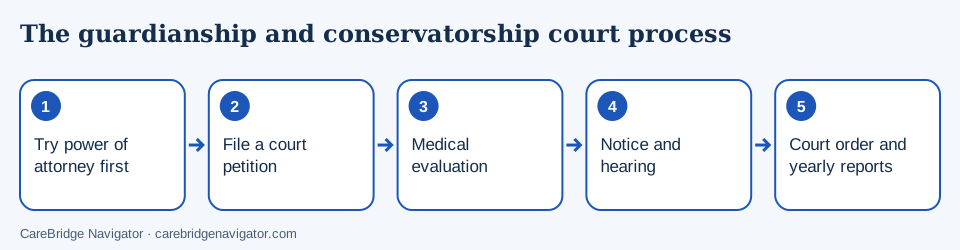
The legal process for guardianship and conservatorship is generally thorough and can be complex, with several stages.
Petition Filing: An interested party, often a family member, begins the process by filing a petition with the appropriate court. The petition explains why guardianship or conservatorship is needed and provides evidence of the person's incapacity.
Notice and Hearings: The court requires formal notice of the petition for the person believed to be incapacitated and their closest relatives. A hearing is then scheduled so all parties can present their case. The person believed to be incapacitated has the right to attend, have legal representation, and present evidence.
Capacity Evaluation: A capacity evaluation is an essential step, typically performed by a physician, psychiatrist, or another qualified professional. The assessment examines the person's ability to understand information, recognize the consequences of decisions, and communicate choices. The evaluation report is key evidence for the court.
Court Order and Oversight: The court issues an order if guardianship or conservatorship is necessary. The order appoints a guardian or conservator and defines their powers and duties. Both roles involve ongoing court oversight, including regular reports and sometimes annual reviews. These checks help ensure guardians and conservators fulfill their responsibilities properly.
The costs of establishing guardianship or conservatorship vary considerably by case complexity, state, and whether anyone contests the case. Legal fees generally range from $1,500 to $10,000 or more. Family disputes or extensive expert evaluations can increase costs. These costs typically cover attorney fees, court filing fees, and fees for court-appointed representatives or evaluators.
Timelines for guardianship and conservatorship proceedings vary widely. An uncontested case might be resolved in 2 to 6 months when everyone agrees and evidence of incapacity is clear. Disagreements, legal challenges, or multiple hearings can extend the process to a year or even longer.
Alternatives to Guardianship and Conservatorship
Families should explore less restrictive alternatives before pursuing guardianship or conservatorship. These options can often provide substantial support without completely removing a person's independence.
Durable Power of Attorney (POA): A Durable Power of Attorney lets a person, called the principal, appoint another person, called the agent, to make financial decisions on their behalf. A Durable Power of Attorney for Healthcare grants similar authority for medical decisions. Other names include Healthcare Proxy and Medical Power of Attorney. These documents are established while the individual still has the capacity to understand and sign them. Planning ahead with these documents can be very effective in avoiding court involvement.
Living Trust: A living trust is a legal document allowing a person to place assets in a trust during their lifetime. The person designates a trustee to manage those assets for their benefit and, later, for their beneficiaries. If the person becomes incapacitated, a designated successor trustee can manage the assets without court involvement.
Supported Decision-Making: Supported decision-making is a newer alternative that helps people with disabilities make their own decisions with support from trusted advisors. Rather than removing rights, the approach helps people understand information, explore options, and communicate choices. Supported decision-making is not a formal legal document like a POA. The approach can be valuable when a person retains some capacity and wants to preserve as much independence as possible.
Representative Payee/VA Fiduciary: A representative payee or VA fiduciary can be appointed to manage specific government benefits, such as Social Security or VA benefits. This limited form of financial management does not cover all assets.
How to Petition for Guardianship or Conservatorship
A guardianship or conservatorship petition becomes necessary when less restrictive alternatives are not workable or existing arrangements provide insufficient support.
1. Consult an Attorney: Consulting an attorney is the most important first step. An elder law or probate attorney can explain your state's requirements. The attorney can also help prepare the necessary documents and represent you in court.
2. Gather Evidence: Family members should collect relevant medical records, financial statements, and other documents showing their parent's incapacity. Affidavits from doctors, social workers, or concerned family members can be valuable.
3. File the Petition: Your attorney will draft and file the formal petition with the appropriate court. The petition explains the reasons for the request and the proposed scope of the guardian's or conservator's authority.
4. Provide Notice: All required parties, including your parent and other close family members, must receive proper notice of the court proceedings.
5. Attend Hearings: Family members pursuing the petition should prepare to attend every scheduled court hearing. You may need to testify and present evidence.
6. Undergo Capacity Evaluation: The court will likely order an independent evaluation of your parent's mental and physical capacity. Cooperate fully with the evaluation process.
7. Court Decision: The judge reviews all evidence before making a decision. The decision must reflect your parent's best interests and the least restrictive alternative available.
Frequently Asked Questions
What is the main difference between guardianship and conservatorship?
Guardianship covers personal and medical decisions for an incapacitated person, called the ward. Conservatorship covers financial decisions for an incapacitated person, called the conservatee. Some states use one term for both, but the roles serve separate functions.
How much does it cost to get guardianship or conservatorship?
Costs typically range from $1,500 for a simple uncontested case to $10,000 or more for contested matters. The total includes attorney fees, court filing fees, capacity evaluations, and court-appointed counsel for the person believed to be incapacitated.
How long does the process take?
Uncontested cases generally take 2-6 months from petition to court order. Contested cases involving family disputes or challenges to capacity findings can take a year or longer.
Can I avoid guardianship or conservatorship?
Your parent may avoid guardianship or conservatorship through planning while still able to understand and sign legal documents. Set up a Durable Power of Attorney for finances, a Healthcare Proxy, and possibly a Living Trust. These planning tools allow trusted family members to step in without court involvement. Supported decision-making is another less restrictive option.
Who can serve as a guardian or conservator?
Most adults over 18 with no felony record can serve. Courts typically prefer family members. A court can appoint a professional fiduciary or public guardian when no suitable family member is available or family conflict exists.
The article provides education only, not legal advice. Laws vary by state. Consult a licensed elder law attorney in your parent's state for guidance specific to your situation.
Sources
- American Bar Association Commission on Law and Aging
- Consumer Financial Protection Bureau: managing someone else’s money
How this guide was written and reviewed
CareBridge Navigator guides are drafted with writing software and research tools, then checked line by line by Shanda Browning Vaughn, RN, a registered nurse since 2000. Shanda confirms every figure against the official sources listed on the page before a guide is published, and updates the guide when Medicare, Medicaid or VA rules change.
Related guides
- Power of Attorney for Aging Parents: A Complete 2026 Legal Guide
- Understanding Power of Attorney for Elderly Parents
- Advance Directives and Living Wills: Step-by-Step for Families in 2026
- Assisted Living vs. Memory Care: Choosing for Dementia
- In-Home Care vs. Assisted Living: 2026 Cost & Lifestyle Guide
More from CareBridge Navigator
- About CareBridge Navigator
- Why Shanda built CareBridge Navigator
- Caregiver directory
- Caregiver community
- Caregiver tax credits
- EEOICPA benefits screener
- Care Agent
- Life Alarm medical alert
- Install the app
- Press and media
Free caregiver tools
- Free care roadmap
- Emergency fridge sheet
- Elder care checklist
- Caregiver questions answered
- Care settings compared
- Compare care options
- Resource directory
- Caregiver education library
More caregiver guides · Start your free CareBridge Navigator assessment