Power of Attorney for Aging Parents: A Complete 2026 Legal Guide
Short answer: A durable power of attorney lets a trusted person handle finances if an older adult can no longer do so, and a health care power of attorney covers medical decisions. Both must be signed while the person still has capacity. Without them, families may need a court guardianship, which is slower and costly.
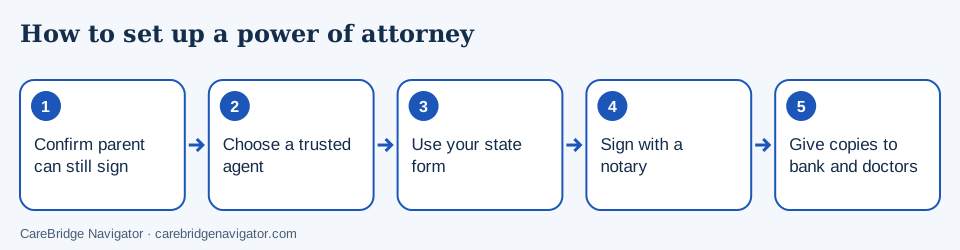
Understanding the Power of Attorney for Aging Parents: A Complete 2026 Legal Guide
The legal side of caring for aging parents can feel overwhelming. A Power of Attorney (POA) is one of the most important documents to consider. A POA gives one person, called the agent or attorney-in-fact, authority to act for another person, called the principal. The authority covers legal or financial matters. The guide explains POAs for adult children helping their aging parents. The information is for educational purposes only, not legal advice. Always consult a qualified attorney for guidance specific to your situation.
What is a Power of Attorney (POA)?
A Power of Attorney is a legal document allowing a principal to name an agent to make decisions on their behalf. The authority can be broad or limited, depending on the document's details. Parents may need a POA as they age and face cognitive decline or physical limitations. Those changes can make managing their affairs difficult. Setting up a POA early ensures someone your parent trusts can make important decisions when needed. Early planning also avoids potential court interventions, such as conservatorships or guardianships, which can be costly and emotionally difficult.
POAs come in several types, each with different features and uses. Understanding the differences helps you choose the right option for your family's needs. The main goal is to help your parent control who makes decisions for them, rather than leaving that choice to a court.
Types of Power of Attorney for Aging Parents
The different types of POAs can be confusing. The following overview explains the most common types used in eldercare:
Durable Power of Attorney (DPOA)
A Durable Power of Attorney is perhaps the most common and important type for aging parents. The word "durable" means the document remains effective if the principal becomes incapacitated or unable to make decisions. Without a durability clause, a regular POA becomes invalid when the principal becomes incapacitated. Durability is important for long-term planning because the agent can continue managing the principal's affairs. A DPOA can grant broad authority over all financial and legal matters. The document can also limit authority to specific actions, such as selling property or accessing certain accounts. Most financial institutions and healthcare providers require a Durable POA when an agent acts for an incapacitated person. Drafting a DPOA requires careful thought and precise legal wording to avoid confusion.
Springing Power of Attorney
A Springing Power of Attorney takes effect only when a specific event or condition occurs. The document clearly defines the "triggering event." Common triggers include the principal's incapacity, certified by one or more physicians, or the principal reaching a certain age. Verifying a triggering event can cause delays and complications. Verification may require multiple medical evaluations or legal interpretations. A springing POA offers a sense of control because the authority does not begin immediately. However, delays can create problems in urgent situations. For that reason, many legal professionals recommend a DPOA effective immediately, particularly when the principal and agent have a high degree of trust.
Healthcare Power of Attorney (HCPOA) / Medical Power of Attorney
A Healthcare Power of Attorney authorizes an agent to make medical decisions when the principal cannot make those decisions. Other names include Medical Power of Attorney and durable power of attorney for healthcare. The authority includes decisions about treatments, medications, surgeries, and end-of-life care. A healthcare POA often works alongside an advance directive or living will. Those documents outline the principal's wishes about specific medical treatments. The agent's role is to ensure those wishes are honored. A healthcare agent needs to understand the principal's values and speak up effectively for the principal with medical professionals.
Financial Power of Attorney
A Financial Power of Attorney gives an agent authority over the principal's financial affairs. The authority can cover managing bank accounts, paying bills, filing taxes, making investment decisions, and handling real estate transactions. A financial POA can be durable or non-durable, immediate or springing. For aging parents, a durable financial POA is generally recommended so financial management continues if the parent becomes incapacitated. The document is essential for preventing gaps in financial management, paying ongoing expenses, and protecting assets. Choosing a financially responsible and trustworthy agent is vital.
When to Set Up a Power of Attorney
The ideal time to set up a Power of Attorney is now, when your parent is still mentally competent. Your parent must be able to understand the document and its effects. Waiting for a crisis or a decline in your parent's cognitive abilities can make the process legally impossible or much more complex. Once a person is deemed mentally incapacitated, the person can no longer legally sign a POA. A court-appointed guardianship or conservatorship then becomes necessary. The process is often more expensive and time-consuming, and takes control away from the family.
Early planning allows your parent to choose an agent thoughtfully and select someone they trust completely. Planning also offers a chance to discuss care and financial preferences, encouraging open family communication. A POA is an essential part of a complete estate plan, alongside wills and trusts.
Choosing the Right Agent (Attorney-in-Fact)
Choosing an agent is one of the most important decisions in the POA process. The agent will have significant authority, so trustworthiness, reliability, and good judgment matter greatly. Key considerations include:
- Trust and Integrity: The agent should have your parent's complete trust. The agent must act in your parent's best interest, not their own.
- Responsibility and Organization: The agent will manage important affairs. The role requires organization, care, and the ability to handle complex tasks.
- Understanding of Principal's Wishes: The agent should clearly understand your parent's values, preferences, and wishes about medical care. Understanding those wishes is especially important for a healthcare POA.
- Availability and Proximity: An agent living nearby can sometimes make managing affairs easier, although proximity is not always necessary.
- Financial Acumen (for Financial POA): A financial agent should understand financial matters or be willing to learn and consult professionals.
- Avoid Conflicts of Interest: The agent should have no conflict of interest compromising their ability to act solely in your parent's best interest.
Naming at least one successor agent is also advisable in case the primary agent cannot or will not serve. Discussing responsibilities with the chosen agent or agents beforehand is crucial. The discussion helps ensure the agents understand and accept the commitment.
State-by-State Differences in POA Laws
Power of Attorney laws can vary significantly between states. General principles remain consistent, but signing requirements, such as the number of witnesses and notarization, can differ. States can also differ in the powers allowed and the wording required for durability. Some states have adopted the Uniform Power of Attorney Act (UPOAA), intended to standardize POA laws across jurisdictions. However, not all states have adopted the entire act, and some have made changes.
Some states, for example, require specific forms prescribed by law for healthcare POAs; others are more flexible. Powers granted by a POA in one state may be interpreted differently in another. Consulting an attorney licensed in your parent's state of residence is strongly recommended because of those differences. The attorney can help ensure the POA is valid and enforceable where needed. Legal advice becomes even more important if your parent divides time between states or the agent lives in another state.
Costs Associated with Setting Up a Power of Attorney
The cost of setting up a Power of Attorney varies widely depending on the method chosen.
- DIY (Do-It-Yourself): Online templates or legal software can help you create a POA. Some resources are free; others charge a small fee, such as $20-$100, to generate the document. DIY is the least expensive option but carries the highest risk of errors, invalidity, or incomplete coverage. Those problems can result from limited legal knowledge or failure to meet state-specific requirements. Institutions can reject a poorly drafted POA, making the document useless.
- Attorney Services: An elder law attorney typically charges between $200 and $500 to draft a Power of Attorney. The cost can sometimes reach $1,000 as part of a broader estate plan. The higher upfront cost provides reassurance that the document is legally sound and tailored to your parent's needs and state laws. Professional drafting also provides reassurance that financial institutions and healthcare providers will accept the document. An attorney can recommend the best POA type for your situation and discuss other relevant estate planning documents.
Professional legal help is often worth the cost, given the potential financial and emotional costs of a contested or invalid POA.
Red Flags of Elder Financial Abuse and How a POA Can Help or Harm
Elder financial abuse is a growing concern. A Power of Attorney can provide strong protection, but an untrustworthy agent can misuse the authority. Important warning signs include:
- Sudden Changes in Financial Behavior: Unexplained withdrawals, new beneficiaries, or large gifts to the agent.
- Isolation of the Elder: The agent preventing family members or friends from contacting the parent.
- Unusual or Illogical Transactions: Financial activities inconsistent with the elder's past patterns or needs.
- Lack of Access to Financial Information: The agent refusing to share information about the elder's finances.
- Discrepancies in Living Conditions: The elder's living conditions worsening despite sufficient funds.
A POA with a trustworthy agent can prevent abuse by allowing a chosen person to manage finances carefully. However, when the agent is the abuser, the POA becomes a tool for abuse. Choose the agent carefully to reduce that risk. Consider requiring multiple signatories for significant transactions, and ensure checks and balances are in place. Regular conversations with your parents about finances and well-being are vital.
How to Revoke a Power of Attorney
The principal can revoke a Power of Attorney at any time, as long as the principal remains mentally competent. Revocation must be in writing and clearly state the principal's intention to revoke the previous POA. The document, often called a "Revocation of Power of Attorney," should be signed, dated, and notarized. Notifying the previously appointed agent about the revocation is also crucial. Any institutions given the original POA, including banks, hospitals, and investment firms, must also receive notice. Without notice, those parties could continue acting under the old POA, leading to complications.
An incapacitated principal may be unable to revoke a POA. In that situation, revoking or challenging the POA requires a court order, typically during a guardianship or conservatorship proceeding. The legal process can be complex and lengthy. Choosing an agent carefully from the start is therefore important.
Frequently Asked Questions
What is the difference between a Durable POA and a regular POA?
A Durable Power of Attorney remains legally effective even if the principal becomes incapacitated. A regular, or non-durable, POA automatically ends if the principal loses mental capacity. For aging parents, a durable POA is almost always recommended. The document ensures continued management of their affairs if they become unable to make decisions.
How much does it cost to set up a Power of Attorney?
POA costs range from $0 for free online templates, which carry risks, to $100 for paid online services. An elder law attorney typically charges $200-$500 to draft the document. Hiring an attorney provides legal reassurance and advice specific to your needs. Professional help can be worth the cost for accuracy and peace of mind.
Can I have more than one agent for my Power of Attorney?
Co-agents can be appointed to act jointly or separately. You can also name successor agents to step in if the primary agent cannot serve. Multiple agents can provide checks and balances. However, the agents must be able to work well together to avoid disputes and delays in decisions.
What if my parent becomes incapacitated before setting up a POA?
A parent becoming incapacitated before establishing a POA will likely require you to petition the court for guardianship or conservatorship. The legal process gives you authority to make decisions for your parent. However, the process can be expensive, time-consuming, and emotionally difficult. The process also removes your parent's ability to choose a decision-maker.
Is a Power of Attorney valid in all states?
A Power of Attorney properly signed under one state's requirements should generally be recognized in another state. However, state POA laws vary significantly. Consulting an attorney licensed in your parent's state of residence is best. The attorney can help ensure the document meets local requirements and is valid and enforceable where needed. Specific considerations may apply if your parent owns assets or lives in multiple states.
What is the role of a notarized signature in a POA?
A notarized signature verifies the signer's identity and confirms the document was signed willingly. Notarization is not always legally required for validity in every state, but is highly recommended for all POAs. Notarization adds assurance of authenticity and can help prevent challenges to the document's legitimacy. Notarization also helps ensure acceptance by financial institutions and other organizations. Many institutions require notarization regardless of state law requirements.
Sources
- Consumer Financial Protection Bureau: managing someone else’s money
- American Bar Association Commission on Law and Aging
How this guide was written and reviewed
CareBridge Navigator guides are drafted with writing software and research tools, then checked line by line by Shanda Browning Vaughn, RN, a registered nurse since 2000. Shanda confirms every figure against the official sources listed on the page before a guide is published, and updates the guide when Medicare, Medicaid or VA rules change.
Related guides
- Understanding Power of Attorney for Elderly Parents
- Advance Directives and Living Wills: Step-by-Step for Families in 2026
- Guardianship vs. Conservatorship: Which Does Your Parent Need?
- Assisted Living vs. Memory Care: Choosing for Dementia
- In-Home Care vs. Assisted Living: 2026 Cost & Lifestyle Guide
More from CareBridge Navigator
- About CareBridge Navigator
- Why Shanda built CareBridge Navigator
- Caregiver directory
- Caregiver community
- Caregiver tax credits
- EEOICPA benefits screener
- Care Agent
- Life Alarm medical alert
- Install the app
- Press and media
Free caregiver tools
- Free care roadmap
- Emergency fridge sheet
- Elder care checklist
- Caregiver questions answered
- Care settings compared
- Compare care options
- Resource directory
- Caregiver education library
More caregiver guides · Start your free CareBridge Navigator assessment