Medicaid Spend-Down Rules Explained Simply
Medicaid Spend-Down Rules Explained Simply
A senior who needs long-term care may need to "spend down" resources if their assets exceed Medicaid limits. Understanding these rules can save families thousands of dollars and prevent costly mistakes.
What Is Medicaid Spend-Down?
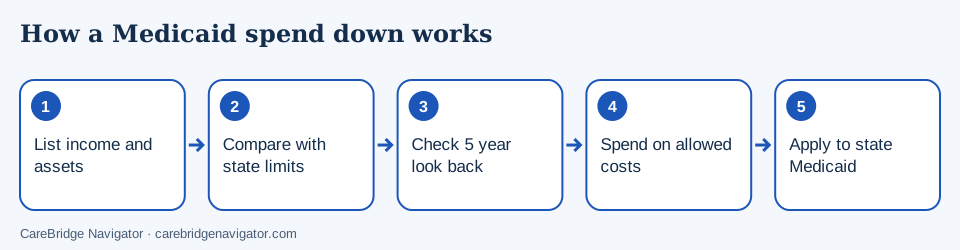
Medicaid has strict income and asset limits for eligibility. Seniors whose countable assets exceed these limits must reduce (or "spend down") their assets to qualify. Spending down doesn't mean wasting money — it means carefully using assets on approved expenses.
2026 Asset Limits
Asset limits vary by state, but general guidelines include:
- Individual: $2,000 in countable assets (some states allow up to $2,000-$15,000)
- Married couple (one spouse applying): The community spouse can typically keep approximately $154,140 in assets (2026 figure)
- Income limit: Varies by state; many use $2,829/month for individuals
What Counts as an Asset?
Countable assets include:
- Cash, checking, and savings accounts
- Stocks, bonds, and investments
- Additional real estate (beyond the primary home)
- Cash value of life insurance policies over $1,500
- Some retirement accounts
Exempt assets include:
- Primary home (up to an equity limit of approximately $713,000 in most states)
- One vehicle
- Personal belongings and household items
- Prepaid funeral and burial plans
- Small life insurance policies (face value under $1,500)
- Wedding and engagement rings
Legal Spend-Down Strategies
#### 1. Pay Off Debts
- Mortgage payments on the primary home
- Credit card debt
- Medical bills
- Car loans
#### 2. Home Improvements
- Accessibility modifications (wheelchair ramps, grab bars, walk-in tubs)
- Necessary repairs (roof, plumbing, heating)
- Energy efficiency upgrades
#### 3. Purchase Exempt Items
- The senior can buy a newer vehicle (only one is exempt)
- The senior can prepay funeral expenses through an irrevocable funeral trust
- The senior can purchase necessary medical equipment
#### 4. Pay for Care Directly
- The senior can pay for home care or assisted living out of pocket until assets are spent down
- The senior can hire family caregivers through a formal caregiver agreement (must be properly documented)
The 5-Year Look-Back Period
The look-back rule is critical: Medicaid reviews all financial transactions from the previous 5 years (60 months) when you apply. If you gave away assets during this period, Medicaid imposes a penalty period when you won't receive benefits.
Common mistakes that trigger penalties:
- Gifts of money to children or grandchildren
- Property transfers to family members
- Asset sales below fair market value
Protecting the Healthy Spouse
When one spouse needs Medicaid for nursing home care, the Community Spouse Resource Allowance (CSRA) protects the healthy spouse from poverty:
- The healthy spouse can keep approximately $30,828 to $154,140 in assets (2026)
- The healthy spouse can keep a minimum monthly income of approximately $2,555
- The healthy spouse keeps the family home as long as the spouse lives there
When to Consult an Elder Law Attorney
Medicaid planning is complex, and mistakes are costly. Consider professional help if:
- Your parent has assets significantly above the limit
- A family home or business is involved
- Transfers were made in the past 5 years
- Your parent is married and needs nursing home care
Start Planning Early
The best time to start Medicaid planning is several years before care is needed. Early planning provides more options and helps avoid the look-back period penalties.
CareBridge Navigator's financial planning tools can help you understand your care costs and explore funding options.
What exactly counts as an asset?
Medicaid divides property into countable and exempt. Countable assets include bank accounts, stocks, bonds, certificates of deposit, second properties, and cash value in some life insurance policies.
Commonly exempt items include the primary home up to an equity limit while a spouse or dependent lives there. Other commonly exempt items include one vehicle, household goods, personal effects, a prepaid irrevocable funeral contract, and certain burial funds. Exact limits are set state by state, so confirm yours before acting on any general figure.
What is the five-year look-back, and what triggers a penalty?
The state reviews the previous 60 months of financial records when someone applies for long-term care Medicaid. Gifts and below-market transfers in that window create a penalty period when Medicaid will not pay for care.
The penalty is calculated by dividing the transferred amount by the state's average monthly cost of nursing home care. Give away $60,000 in a state with a $6,000 monthly divisor, and Medicaid will not pay for roughly ten months. The penalty begins when the person is otherwise eligible and already needs care. Losing coverage at that point hurts most.
Payments to a family caregiver without a written personal care agreement are among the most common accidental transfers. Adding an adult child to a deed is another common accidental transfer.
How does a spouse at home avoid being left with nothing?
Federal rules protect the community spouse. The Community Spouse Resource Allowance lets the at-home spouse keep a share of countable assets. Federal minimum and maximum limits apply to that share and change annually. The Minimum Monthly Maintenance Needs Allowance lets the at-home spouse keep part of the other spouse's income.
Spousal protections are not automatic in practice. The protections must be claimed correctly on the application, and a fair hearing may be needed in difficult cases.
Which spend-down moves are legitimate?
Spending down for the applicant's own benefit is allowed. Recognized strategies include paying off the mortgage, paying legitimate medical and dental bills, and repairing the roof. Other recognized strategies include buying a reliable vehicle and prepaying funeral and burial costs. Buying a Medicaid-compliant annuity is also a recognized strategy in some states.
Gifts of money to children cause the most damage. Transferring the house to a child to protect the home is also especially damaging. Both usually create a penalty and can create a tax problem as well.
Who should you call before you move any money?
An elder law attorney licensed in your state should be your first call, before a single transfer. One consultation costs a fraction of one month of nursing home care. You can also get free help through your State Health Insurance Assistance Program and your local Area Agency on Aging.
Sources
- Medicaid.gov: eligibility
- Medicaid.gov: spousal impoverishment
- Eldercare Locator (U.S. Administration for Community Living)
How this guide was written and reviewed
CareBridge Navigator guides are drafted with writing software and research tools, then checked line by line by Shanda Browning Vaughn, RN, a registered nurse since 2000. Shanda confirms every figure against the official sources listed on the page before a guide is published, and updates the guide when Medicare, Medicaid or VA rules change.
Related guides
- Understanding Medicare Part A vs Part B for Senior Care
- Long-Term Care Insurance: Is It Worth the Cost?
- Medicare vs Medicaid: What's the Difference for Seniors?
- Understanding Power of Attorney for Elderly Parents
- Top 10 Questions to Ask When Touring Assisted Living
More from CareBridge Navigator
- About CareBridge Navigator
- Why Shanda built CareBridge Navigator
- Caregiver directory
- Caregiver community
- Caregiver tax credits
- EEOICPA benefits screener
- Care Agent
- Life Alarm medical alert
- Install the app
- Press and media
Free caregiver tools
- Free care roadmap
- Emergency fridge sheet
- Elder care checklist
- Caregiver questions answered
- Care settings compared
- Compare care options
- Resource directory
- Caregiver education library
More caregiver guides · Start your free CareBridge Navigator assessment